Food businesses print for two audiences that never meet — the person at the table and the person receiving a delivery. Both matter, and the delivery side has quietly become the larger requirement.
In the restaurant
- Menu cards. Laminated 300 GSM card as a minimum; synthetic waterproof stock in high-turnover outlets.
- Table tents for specials and offers, which change more often than the menu.
- Bill books, and kitchen order tickets if you run table service.
- Staff uniforms — different fabrics for kitchen and service.
- Window graphics and an outdoor signboard built for sun and monsoon.
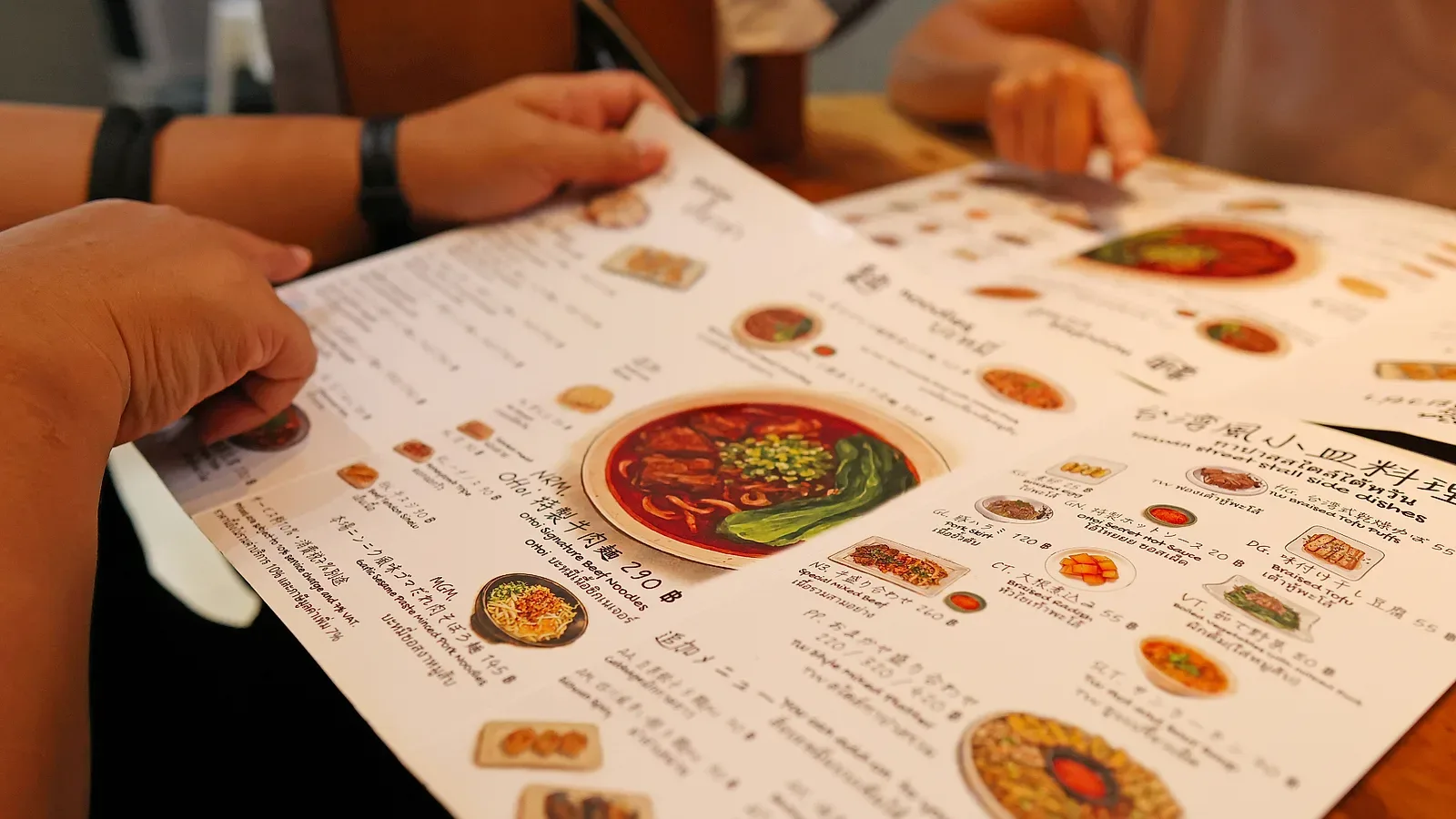
The menu is the only printed item every single customer holds. A sticky, curled menu with a price corrected in pen undoes a lot of work done in the kitchen.
For delivery
- Tamper-evident seals. These address the main anxiety about delivered food and brand the bag at the same time.
- Bag stickers, which turn a plain delivery bag into branded packaging at a very low unit cost.
- Container labels with item, spice level and reheating information.
- An insert card with a discount code, a QR review link, or a WhatsApp number for direct ordering.
Use vinyl, not paper, for anything on a delivery bag. Paper stickers soften with condensation and oil and look poor by the time the bag arrives.
Handling price changes without reprinting everything
This is the recurring cost most restaurants underestimate. Two approaches work: a menu format with replaceable inserts, so a revision costs one page rather than the whole menu; or keeping prices on a separate panel or insert card while the descriptive pages stay unchanged.
Either is far cheaper than a full reprint, and both avoid the pen-corrected price that customers notice immediately.
Multi-outlet groups
If you run several outlets with different pricing, common pages can be printed together with only the price panel varying per location. That keeps the cost close to a single-outlet run while letting each outlet show its own rates.
What a cloud kitchen should prioritise
With no dine-in space, packaging is the entire brand experience. The order of priority is: tamper-evident seal, bag sticker, container label, insert card. Everything else can wait.
If you run several brands from one kitchen, print all the sticker identities together on shared sheets. It costs considerably less than separate runs for each brand.
Material decisions worth making once
| In-house menu | Laminated 300 GSM card, round corners to reduce dog-earing. |
|---|---|
| High-turnover menu | Synthetic waterproof stock. Costs more, lasts considerably longer. |
| Takeaway menu | Light art paper. It is given away, so unit cost matters more than durability. |
| Delivery seal | Vinyl with tamper-evident properties. |
| Outdoor signboard | ACP or outdoor-grade board with UV-stable printing. |
None of these are expensive decisions individually. Together they are the difference between material that still looks good in six months and material that has to be replaced in six weeks.